
Flutter vs Native: Time to End the Debate
I hear the question "Flutter or native?" a lot these days. Let me be honest: that sentence now sounds a bit dated to me. Because for someone who has actually used Flutter and shipped a production app, this debate has long since moved elsewhere.
If we are still stuck on the point of "should we pick Flutter or native?", it usually means we are not looking at the whole picture. By the time we reached 2025, this debate stopped being a technical one. It has become more about how we make decisions and how we approach the project.
Let's clarify one thing upfront. Flutter already runs natively. Dart code is compiled AOT. It produces a native binary on Android, and a native binary on iOS. The UI does not run through a WebView, and there is no JavaScript. Flutter draws the screen directly to the GPU with its own render engine. So Flutter is not web, it is not hybrid, and it is certainly not React Native. This part is no longer up for debate.
So why does the phrase "native is more performant" keep going around?
I think what gets mixed up here is putting performance and control on the same scale. But they are different things. And that is exactly where the confusion comes from.
Let's talk about the UI side. Animations, scrolls, screen transitions... Between a well-written Flutter app and a native app, there is no performance difference the user can feel. In fact, on some animation-heavy screens Flutter can even be more consistent. The reason is that it has a single render pipeline. So criticizing Flutter over UI performance today does not make much sense to me.
The real difference starts with how close the work is to the platform.
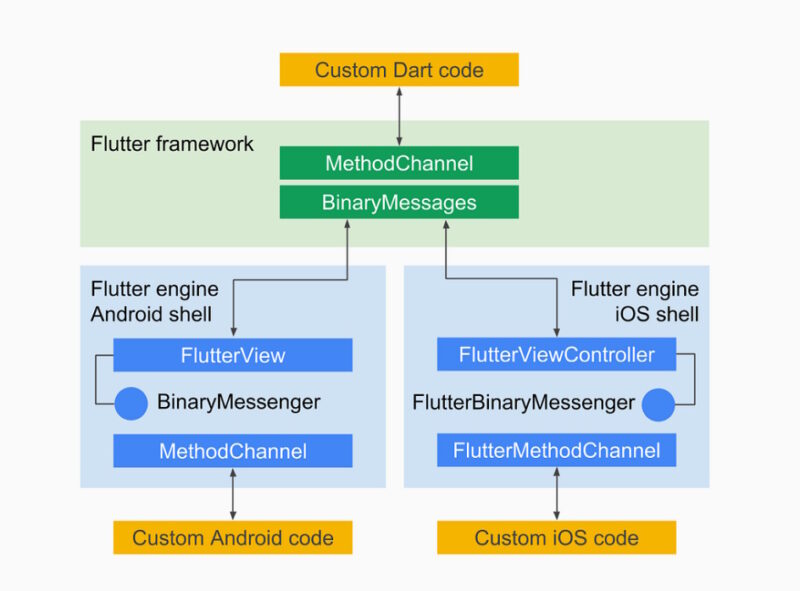
When developing native, you are inside the operating system. The lifecycle is in your hands, background services are under your control, and you have direct say in matters like sensors, Bluetooth, and the camera. With Flutter, things move in a slightly more layered way. You are on the Dart side, and you use a platform channel to cross over to the native side. This is not a bad thing, but you have to accept this fact: Flutter is very close to native, but it is not as "inside" as native.
This difference does not show up in every project. In fact, in many projects you never even feel it. But in some projects it becomes clear. Especially in apps that do heavy background work, constantly read sensors, or run very sensitively to the OS lifecycle, Flutter alone starts to fall short. At that point you usually go the route of writing Flutter plus a native plugin. That is not a wrong approach, but you have accepted that you are no longer in pure Flutter.
By the way, I also want to say this clearly. Most of the performance problems experienced in Flutter projects do not come from Flutter. Wrong state management, unnecessary rebuilds, complex widget trees, poor architecture... If these exist, you would have the same problems writing native. Flutter just becomes the scapegoat at that point.
My observation is this: this debate has not ended for years because the technology choice and the setup of a proper Flutter structure are usually questioned not before the project starts, but after problems come up. The project slows down, the team struggles, maintenance costs rise... Then people turn around and ask, "Was Flutter the mistake?" But most of the time the problem lies in wrong initial decisions.
Let me speak from my own experience. There have been many projects where I used Flutter and said, "Good thing we chose Flutter." In fact, I have never regretted this choice. Only in the early days when we first moved to Flutter did we make some mistakes. 🙂 We quickly noticed and corrected them, and we became masters of it.
In projects where we needed to ship an MVP fast, wanted to reach iOS and Android at the same time with a single codebase, and where UI and iteration speed were critical, Flutter was genuinely very strong. In one project, for the first time after a long while since we started, I hit a spot where Flutter's libraries were not enough. There we wrote our own plugin and solved it. So again, we had no problems.
Here the matter is not only technical, it is also about team structure. If you have a small team, a product that needs to move fast, and a limited budget, Flutter gives a serious advantage. But when it comes to large teams, long-term enterprise projects, and structures with very frequent developer turnover, the impact of the technology choice on maintenance cost becomes much more pronounced.
The bill for a wrong technology choice usually does not come immediately. In the first months everything goes well. But six months later, phrases like "let's not touch this", "let's not break that part", "changing this is risky" start to pile up. At that point the matter stops being Flutter vs Native and becomes whether the right decision was made.
So in my view, the question "is Flutter or Native faster?" is now the wrong question. The real question should be: how close does this project have to be to the operating system? If the answer is "very close", then native is the better choice. If the answer is "not really necessary", then Flutter is a perfectly strong solution.
To sum up, instead of the Flutter vs native question, the real question is closeness to the operating system and how much OS-based work it does. The choice should be made accordingly, in my opinion. Only if it works very deeply with the OS and there is a situation where the libraries would cause performance problems would I choose native. Otherwise, at the point we have reached today, I definitely recommend continuing with Flutter in terms of performance, cost, and code readability. But let me end by adding one very important note. It will not work if you do not set up a proper Flutter structure. Then, instead of blaming Flutter, you need to focus on what the people who set up the structure did. In other words, everyone can show up today saying "Flutter is easy, I can do it", but how proper a structure they set up and whether they pay attention to performance is very debatable. You can reach a point where you say, "I wish we had done native" if a careful and proper structure is not set up.